
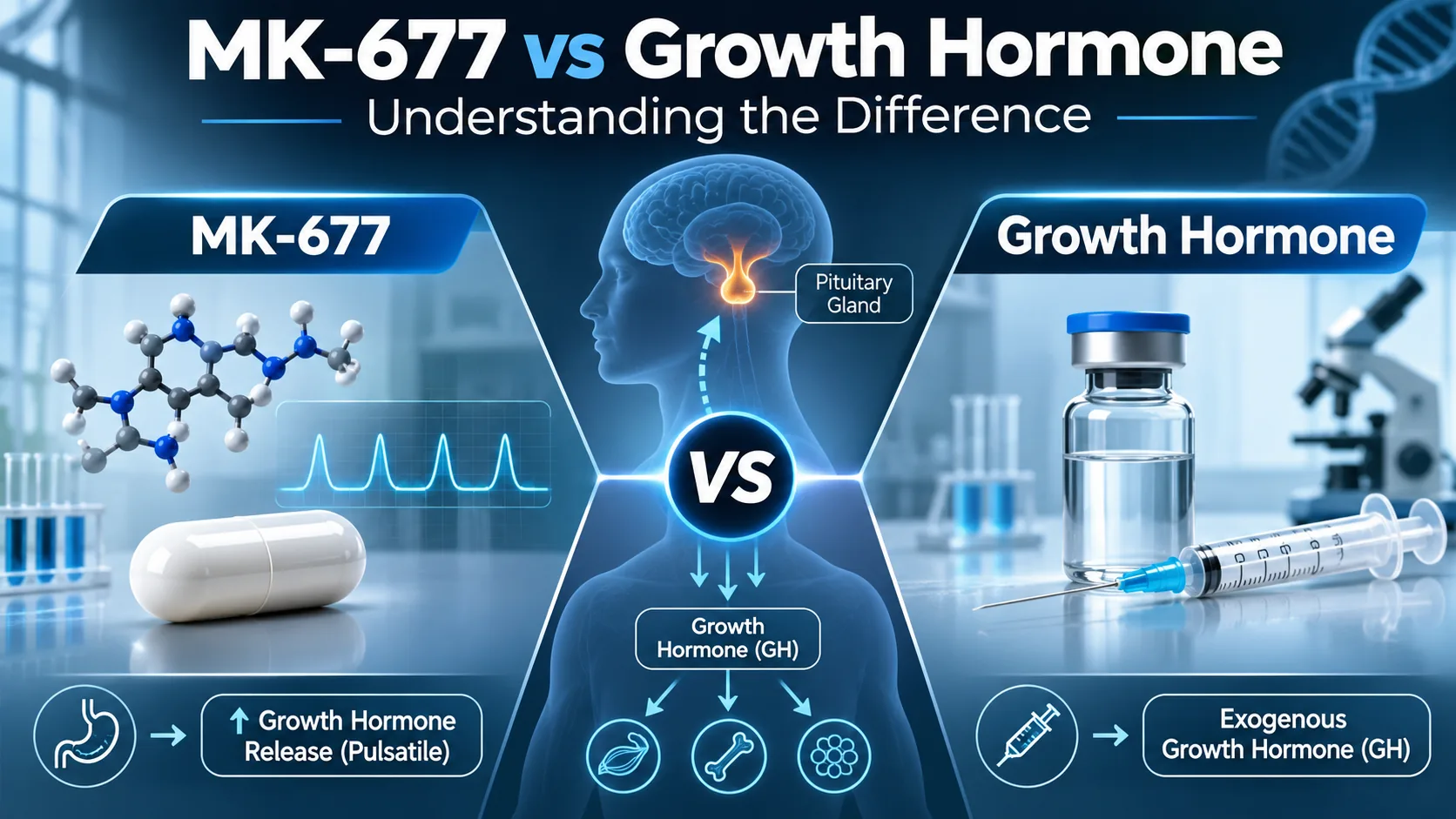
MK-677 (Ibutamoren) and human growth hormone (HGH) are often discussed together because both influence growth hormone activity. However, the way they interact with the body’s endocrine system is fundamentally different.
While HGH administration introduces growth hormone directly into circulation, MK-677 stimulates the body’s existing hormone-release mechanisms.
Understanding this distinction helps explain why researchers investigate these approaches separately and why their biological effects cannot automatically be considered equivalent.
MK-677 vs HGH: The Key Differences
MK-677 is an orally active growth hormone secretagogue that interacts with the ghrelin receptor. HGH, by contrast, is a peptide hormone that can be administered directly through pharmaceutical preparations.
| Characteristic | MK-677 (Ibutamoren) | Human Growth Hormone (HGH) |
|---|---|---|
| Classification | Growth hormone secretagogue | Peptide hormone |
| Mechanism | Stimulates endogenous GH secretion | Introduces GH directly |
| Administration | Oral in clinical studies | Injection |
| Hormone source | Pituitary gland | Externally administered |
| Natural GH pulses | Influences existing secretion patterns | Does not require natural GH pulses |
| Regulatory status | Investigational compound | Approved for specific medical conditions |
Although both approaches can influence the growth hormone system, their mechanisms are not interchangeable.
How MK-677 Influences Natural Growth Hormone Pulses
Growth hormone is naturally released in pulses rather than continuously. These fluctuations are regulated by interactions between the hypothalamus, pituitary gland and several hormonal signals.
MK-677 works within this existing regulatory system.
In a controlled human study, Chapman and colleagues demonstrated that MK-677 enhanced established growth hormone secretion pulses, increasing their amplitude without significantly changing their frequency.
This differs from administering HGH directly, which introduces additional hormone independently of the body’s natural secretion process.
The distinction is important because the timing, regulation and source of growth hormone exposure can influence how researchers interpret hormonal responses.
Why Pituitary Function Makes a Difference
One of the most significant differences between MK-677 and HGH concerns the pituitary gland.
Because MK-677 stimulates endogenous growth hormone release, its activity depends partly on the body’s remaining ability to produce and secrete the hormone.
This becomes particularly relevant in research involving growth hormone deficiency.
A 1997 clinical investigation involving adults with growth hormone deficiency found that responses to MK-677 varied according to the participants’ existing GH and IGF-1 status. Individuals with less severe deficiency generally demonstrated stronger hormonal responses.
This highlights a key limitation of growth hormone secretagogues: stimulating hormone release is not equivalent to supplying the hormone itself.
Externally administered HGH can provide growth hormone without depending on the pituitary gland’s ability to release it, although treatment responses remain subject to other physiological factors.
This fundamental difference helps explain why MK-677 cannot be regarded as a direct substitute for HGH in clinical treatment.
Does MK-677 Produce the Same Results as HGH?
Not necessarily.
Both approaches can increase measurable growth hormone activity, but similar hormonal changes do not establish identical physiological outcomes.
Clinical investigations of MK-677 have demonstrated changes in circulating hormone concentrations and certain body-composition measurements. However, these findings do not establish therapeutic equivalence with approved growth hormone treatments.
For example, a randomised study published in Annals of Internal Medicine reported increased fat-free mass during MK-677 treatment in older adults, without corresponding improvements in strength or physical function. Changes in glucose regulation were also observed.
The available evidence therefore supports distinguishing measurable hormonal activity from demonstrated clinical benefit.
What Does This Mean for MK-677 Research?
The scientific interest in MK-677 lies partly in its ability to stimulate growth hormone secretion through an oral, non-peptide compound.
Rather than replacing growth hormone, MK-677 provides researchers with a different method of investigating how the body’s own hormonal signalling responds to stimulation.
Its dependence on endogenous secretion, influence on natural hormone pulses and variable responses across different study populations make it distinct from direct HGH administration.
These characteristics remain important when interpreting published findings and identifying the limitations of existing research.
Further MK-677 Research
For a broader overview of Ibutamoren, including its mechanism, clinical evidence and analytical quality considerations, explore our Understanding MK-677: Research, Mechanism and Quality master guide.
You can also view our MK-677 (Ibutamoren) research product for product specifications and laboratory documentation, or explore the wider MK-677 research range.
Conclusion
MK-677 and HGH influence the same hormonal system through distinctly different mechanisms.
MK-677 stimulates the body’s existing growth hormone release pathways, while administered HGH introduces the hormone directly.
The distinction becomes particularly significant when considering natural secretion patterns, pituitary function and differences in individual hormonal responses.
Understanding these mechanisms provides a more accurate basis for interpreting the research without assuming that the two approaches deliver equivalent outcomes.
Scientific References
Chapman IM et al. (1996) – Stimulation of the GH–IGF-1 Axis by MK-677 in Healthy Elderly Subjects – Journal of Clinical Endocrinology & Metabolism.
Chapman IM et al. (1997) – MK-677 and Growth Hormone Secretion in Selected GH-Deficient Adults – Journal of Clinical Endocrinology & Metabolism.
Nass R et al. (2008) – Effects of an Oral Ghrelin Mimetic on Body Composition and Clinical Outcomes – Annals of Internal Medicine.
Research disclaimer: MK-677 is an investigational compound and is not approved for human consumption or medical treatment. This article is provided for educational and scientific reference purposes only and does not constitute medical advice.