
Disclaimer: This article is for educational purposes only. MK-677 (Ibutamoren) is supplied strictly for research purposes only and is not approved for human consumption.
Introduction
MK-677, also known as Ibutamoren, is an investigational compound that has attracted considerable research interest because of its interaction with the growth hormone (GH) and insulin-like growth factor-1 (IGF-1) axis.
Although MK-677 is frequently discussed alongside selective androgen receptor modulators (SARMs), this classification is inaccurate. MK-677 does not act by selectively binding to androgen receptors. Instead, it is an orally active growth hormone secretagogue and ghrelin receptor agonist.
This distinction is important when interpreting both the scientific literature and the growing amount of information about MK-677 found online.
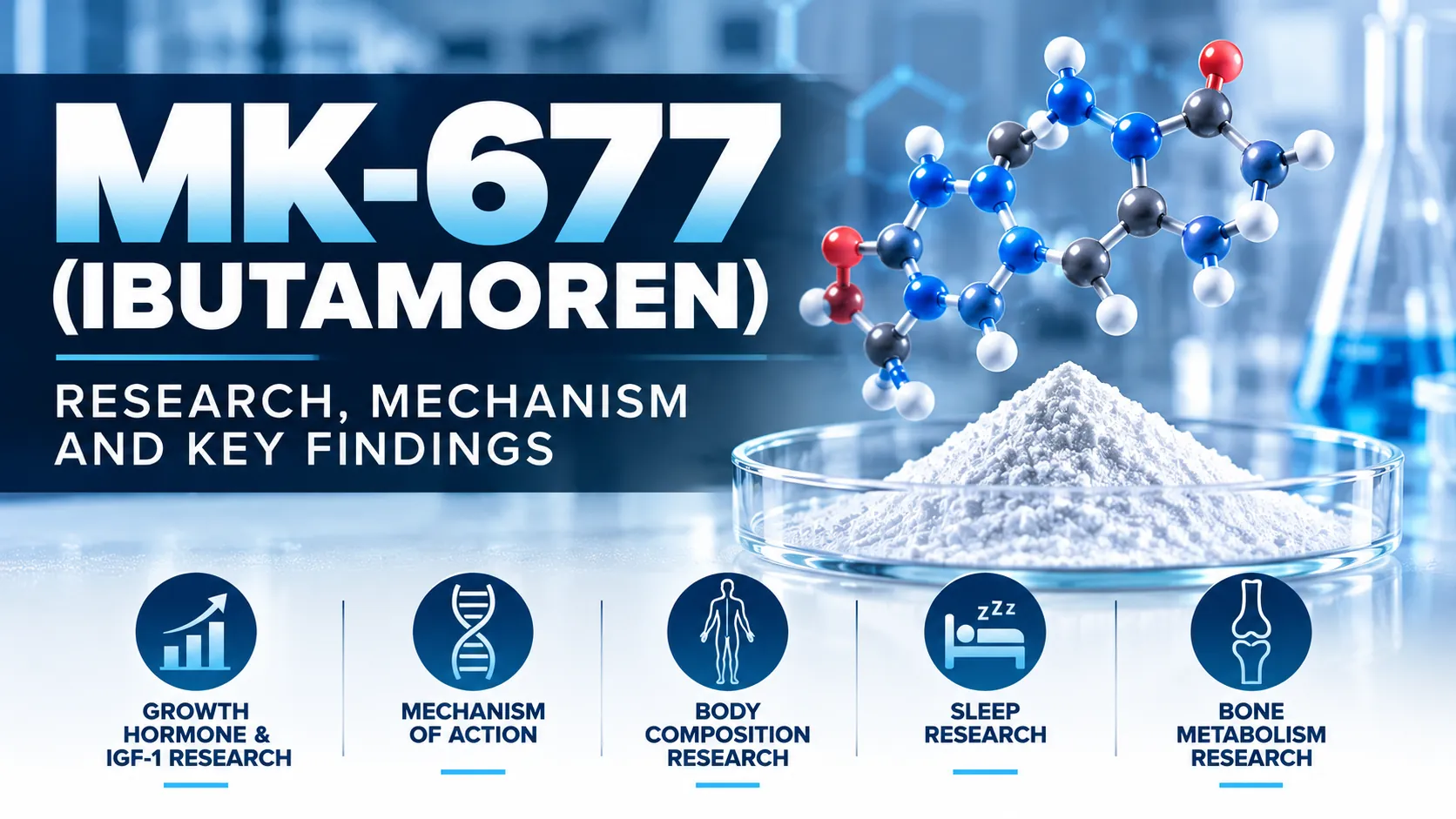
Research involving MK-677 has investigated areas including growth hormone secretion, IGF-1, body composition, sleep, bone turnover and age-related physiological changes. However, the findings should be considered within the limitations of the individual studies, and MK-677 remains an investigational compound rather than an approved nutritional supplement or medicine.
How Does MK-677 Work?
Growth hormone secretion is naturally regulated through a complex endocrine system involving several signalling pathways.
MK-677 interacts with the growth hormone secretagogue receptor (GHS-R), also commonly known as the ghrelin receptor.
Ghrelin is a naturally occurring hormone involved in several physiological processes, including appetite regulation and growth hormone secretion. By activating this receptor, MK-677 can stimulate the body’s existing pulsatile release of growth hormone.
This mechanism distinguishes it from administering growth hormone itself.
An early human study published in the Journal of Clinical Endocrinology & Metabolism examined MK-677 in healthy older adults. Researchers reported increased pulsatile GH secretion and increases in serum IGF-1 following administration of MK-677.
Importantly, this demonstrates a biological effect on the GH/IGF-1 axis; it does not by itself establish a clinical benefit.
MK-677 and IGF-1 Research
IGF-1 is produced predominantly by the liver in response to growth hormone signalling and plays a role in numerous physiological processes.
This has made changes in IGF-1 one of the most frequently measured outcomes in MK-677 research.
Several human studies have reported increases in circulating IGF-1 following MK-677 administration.
For example, a randomized study involving obese adult males reported an approximately 40% increase in serum IGF-1 during the study period.
A longer randomized controlled trial involving healthy adults aged 60 to 81 also found that MK-677 increased both growth hormone and IGF-1 concentrations.
These findings provide reasonably consistent evidence that MK-677 can influence the GH/IGF-1 axis under controlled research conditions.
What they do not establish is that increasing these biomarkers necessarily produces improvements in every downstream outcome sometimes associated with growth hormone.
That distinction is essential when interpreting research.
What Has Research Found About Body Composition?
Body composition has been another significant area of MK-677 investigation.
In the year-long randomized trial involving healthy older adults, fat-free mass increased in the MK-677 group while it declined slightly in participants receiving placebo.
However, the researchers did not observe corresponding improvements in strength or physical function.
Body weight also increased more in the MK-677 group.
Similarly, research involving obese males reported changes in fat-free mass alongside increased GH and IGF-1.
These results illustrate why research findings should not be reduced to simple claims such as “MK-677 builds muscle.”
Fat-free mass is not synonymous with contractile muscle tissue, and changes in body composition measurements can be influenced by several factors, including body water.
The scientific evidence is therefore more nuanced than many simplified descriptions found online.
MK-677 and Sleep Research
Sleep represents another interesting area of investigation.
Growth hormone secretion is closely associated with sleep architecture, particularly deeper stages of sleep.
A controlled human study examining MK-677 reported changes in sleep parameters in both younger and older participants.
In younger subjects, the higher investigated dose was associated with increased stage IV sleep and REM sleep compared with placebo. Older participants also experienced changes in REM sleep.
These findings are scientifically interesting, but the studies were relatively small and should not be interpreted as establishing MK-677 as a treatment for sleep disorders.
Instead, they provide another example of how manipulation of the ghrelin/GH signalling pathway may influence physiological processes beyond a single biomarker.
Research Into Bone Metabolism
Researchers have also investigated whether changes in GH and IGF-1 signalling influence markers associated with bone metabolism.
Studies involving older adults found increases in biochemical markers of bone formation and resorption following MK-677 administration.
This suggested increased bone turnover.
Again, biochemical markers are not the same thing as demonstrating a reduction in fracture risk or establishing a treatment for osteoporosis.
This distinction between biological activity and proven clinical benefit is particularly important when evaluating investigational compounds.
Not Every Clinical Investigation Has Produced Positive Results
A balanced examination of MK-677 should also consider research where increased IGF-1 did not translate into the desired clinical outcome.
One large randomized study investigated MK-677 in more than 500 people with mild-to-moderate Alzheimer’s disease.
Although serum IGF-1 increased substantially, researchers found no significant benefit in measures of disease progression.
Another randomized study investigated MK-677 in older patients recovering from hip fracture. Some measures differed between groups, while several other measures of physical performance did not improve.
These studies provide a useful reminder that demonstrating target engagement — such as increasing IGF-1 — is fundamentally different from demonstrating meaningful clinical efficacy.
Potential Adverse Effects and Research Limitations
MK-677 should not be portrayed as risk-free.
Human studies have reported effects including increased appetite, transient oedema, muscle discomfort and changes in glucose regulation or insulin sensitivity.
In the year-long study of healthy older adults, fasting blood glucose increased modestly and insulin sensitivity decreased.
Questions also remain regarding long-term safety.
For these reasons, MK-677 continues to be an investigational substance, and research findings should not be interpreted as evidence that it has been established as safe or effective for general human use.
For a more focused examination of reported adverse findings and the limitations of the available evidence, see our MK-677 side effects research guide.
Why Product Identity and Analytical Testing Matter
The growing online interest in research compounds introduces another issue that is separate from their pharmacology: product identity.
Scientific literature examining a compound only has practical relevance to research material if the material actually contains what its label claims.
For this reason, analytical documentation can be particularly important when evaluating research compounds.
Researchers and laboratories may use techniques such as high-performance liquid chromatography (HPLC) and mass spectrometry (MS) to investigate characteristics including identity and purity.
HPLC can help separate and quantify components within a sample, while mass spectrometry can provide information that helps confirm molecular identity.
Neither technique proves that a compound is safe or effective. Instead, they address a more fundamental analytical question: what is actually present in the sample being examined?
You can learn more about our approach to independent analytical testing, Certificates of Analysis and product transparency on our Testing & Quality page.
For those reviewing commercially available research material, documentation should therefore be considered separately from marketing claims.
For example, UK supplier Affordable Nutrition provides product specifications and supporting analytical information alongside its MK-677 (Ibutamoren) research product, allowing researchers to review relevant product information rather than relying solely on promotional descriptions.
Where available, batch or sample-specific analytical documentation provides considerably more useful information than an unsupported percentage printed on a label.
How to Interpret a Certificate of Analysis
A Certificate of Analysis, commonly abbreviated to COA, can provide useful information about an analysed sample, but it is important to understand what the document actually demonstrates.
Depending on the laboratory and analytical methods used, documentation may include:
- identification of the submitted sample;
- reported purity or assay results;
- chromatographic data;
- molecular or mass-spectrometry information;
- batch or sample references; and
- the analytical methods used.
A credible COA should not be interpreted as regulatory approval or evidence of clinical safety.
It should instead be viewed for what it is: documentation relating to the analytical characteristics of the particular material tested.
This is an important distinction because analytical purity, pharmacological activity, clinical efficacy and safety are four different questions.
Looking Beyond Marketing Claims
MK-677 provides a useful example of why research compounds should be examined through primary scientific literature rather than online claims alone.
There is legitimate human research demonstrating that MK-677 interacts with the ghrelin receptor pathway and can alter GH and IGF-1 concentrations.
Research has also investigated body composition, sleep, bone turnover and several clinical applications.
At the same time, the evidence has important limitations.
Changes in biomarkers have not consistently translated into improvements in clinical outcomes, potential adverse effects have been identified, and significant questions surrounding long-term use remain unresolved.
The most responsible approach is therefore neither to dismiss MK-677 as having no scientific basis nor to extrapolate limited findings into claims that research has not established.
Conclusion
MK-677 (Ibutamoren) remains an interesting investigational compound because of its ability to interact with the ghrelin receptor and influence the body’s growth hormone and IGF-1 signalling pathways.
Human studies provide evidence of biological activity and have explored potential effects on areas including body composition, sleep and bone metabolism. However, these findings need to be interpreted alongside negative or inconclusive clinical outcomes, reported adverse effects and the continuing absence of established long-term safety data.
As interest in MK-677 continues, two principles remain particularly important: quality of evidence and quality of material.
Primary research can help establish what scientists have actually observed, while appropriate analytical testing can help establish the identity and characteristics of the material being investigated.
Keeping those questions separate from marketing claims provides a much more reliable foundation for understanding MK-677 and the research surrounding it.
References
Nass R, et al. Effects of an oral ghrelin mimetic on body composition and clinical outcomes in healthy older adults: a randomized trial. Annals of Internal Medicine. 2008.
Chapman IM, et al. Stimulation of the growth hormone (GH)-insulin-like growth factor I axis by daily oral administration of a GH secretagogue (MK-677) in healthy elderly subjects. Journal of Clinical Endocrinology & Metabolism. 1996.
Svensson J, et al. Two-month treatment of obese subjects with the oral growth hormone secretagogue MK-677 increases GH secretion, fat-free mass, and energy expenditure. Journal of Clinical Endocrinology & Metabolism. 1998.
Copinschi G, et al. Prolonged oral treatment with MK-677, a novel growth hormone secretagogue, improves sleep quality in man. Neuroendocrinology. 1997.
Murphy MG, et al. Oral administration of the growth hormone secretagogue MK-677 increases markers of bone turnover in healthy and functionally impaired elderly adults. Journal of Bone and Mineral Research. 1999.
Sevigny JJ, et al. Growth hormone secretagogue MK-677: no clinical effect on Alzheimer disease progression in a randomized trial. Neurology. 2008.
Adunsky A, et al. MK-0677 (ibutamoren mesylate) for the treatment of patients recovering from hip fracture: a multicenter, randomized, placebo-controlled phase IIb study. Archives of Gerontology and Geriatrics. 2011.