
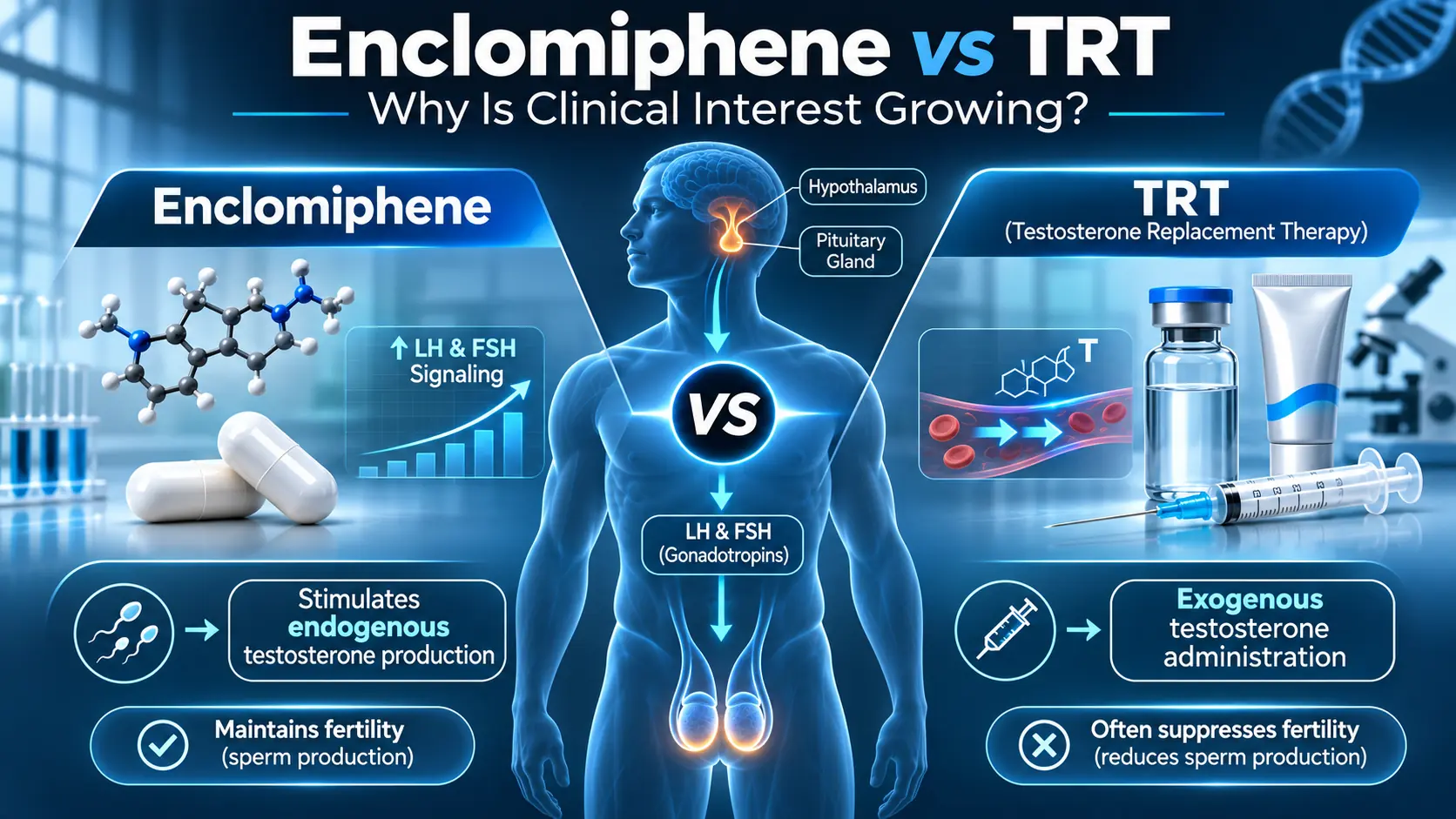
Testosterone replacement therapy (TRT) has long been an established treatment for men diagnosed with testosterone deficiency. However, increasing interest in alternative approaches is raising an important question: could stimulating the body’s own testosterone production offer advantages for certain patients?
One compound attracting particular attention is Enclomiphene Citrate, an investigational selective oestrogen receptor modulator (SERM) studied for its potential role in male hypogonadism.
Recent clinical publications and growing specialist interest suggest that Enclomiphene could have a role in future treatment discussions, particularly where preserving natural hormonal function and fertility is a priority.
Why Are Alternatives to Traditional TRT Being Explored?
TRT is an established treatment for appropriately diagnosed testosterone deficiency, but it isn’t necessarily the preferred option in every clinical situation.
One important consideration is fertility.
Externally administered testosterone can suppress the hormonal signals responsible for maintaining sperm production. Consequently, conventional TRT may be unsuitable for men who wish to preserve their fertility.
This has encouraged researchers to investigate approaches that support endogenous testosterone production rather than introducing testosterone directly.
Enclomiphene has attracted attention because controlled studies have demonstrated increases in testosterone while maintaining reproductive hormonal signalling.
This distinction creates potential clinical interest, particularly among men with secondary hypogonadism whose hormone-production pathways remain responsive.
For a more detailed examination of the underlying science, explore our Enclomiphene Citrate: Mechanism, Testosterone Research and Clinical Evidence master guide.
A Significant Development: The BSSM’s 2026 Position Statement
A notable development came in 2026 when the British Society for Sexual Medicine (BSSM) published a position statement examining Enclomiphene’s potential role in treating male hypogonadism.
The statement recognised Enclomiphene as a promising investigational option, particularly for selected patients with secondary hypogonadism and fertility considerations.
However, the BSSM stopped short of recommending its routine use as an established alternative to TRT.
Instead, it emphasised the need for appropriate patient selection, experienced clinical supervision and further research into long-term safety and effectiveness.
The significance lies in Enclomiphene receiving serious consideration from a recognised professional medical organisation, while its investigational status remains clearly acknowledged.
Read the BSSM’s 2026 position statement.
Why Patient Selection Is So Important
Not all testosterone deficiency has the same underlying cause.
In secondary hypogonadism, insufficient hormonal stimulation contributes to reduced testosterone production. In primary hypogonadism, the problem lies principally with the testes themselves.
This distinction is especially important when considering treatments that depend on the body’s existing hormone-production pathways.
Where testicular function is significantly impaired, increasing hormonal stimulation may not produce the desired response.
Consequently, Enclomiphene cannot be viewed as a universal replacement for testosterone therapy.
Its potential relevance depends on the underlying cause of testosterone deficiency, individual physiological factors and appropriate medical assessment.
Growing Clinical Interest in Enclomiphene
Interest in Enclomiphene has developed beyond its earlier clinical trials, with renewed attention to its potential role in managing certain forms of male hypogonadism.
The BSSM’s 2026 position statement is particularly noteworthy because it brings together existing clinical evidence and identifies circumstances in which further investigation may be valuable.
This reflects a broader interest in approaches that preserve endogenous hormonal activity rather than relying exclusively on externally administered testosterone.
However, clinical interest should not be confused with established treatment status.
Enclomiphene remains an unlicensed medicine in the UK, and its potential therapeutic role continues to require careful evaluation.
What Does the Latest Clinical Evidence Tell Us?
A 2025 systematic review and meta-analysis examined randomised controlled trials involving Clomiphene and Enclomiphene in men with functional hypogonadism.
The findings supported improvements in several hormonal measurements, including testosterone and reproductive hormone concentrations.
However, the review combined evidence from two related but pharmacologically distinct compounds, meaning its findings cannot automatically be attributed to Enclomiphene alone.
Furthermore, improvements in laboratory measurements do not necessarily demonstrate equivalent improvements in symptoms, quality of life or long-term health outcomes.
Read the 2025 systematic review and meta-analysis.
This distinction remains central to evaluating Enclomiphene’s potential.
Although its hormonal effects are supported by controlled studies, important questions remain concerning sustained symptom improvement, reproductive outcomes and longer-term safety.
Could Enclomiphene Become an Established TRT Alternative?
The possibility remains scientifically interesting, but several questions must be answered before Enclomiphene can be regarded as an established treatment option.
Further clinical investigation is needed to determine whether its hormonal effects consistently translate into meaningful improvements in wellbeing, sexual function and other symptoms associated with testosterone deficiency.
Longer-term safety data are also essential, particularly because testosterone-related treatment decisions may involve extended periods of medical management.
Ultimately, Enclomiphene’s future clinical role will depend not simply on its ability to increase testosterone concentrations, but on whether it can demonstrate sustained benefits with an acceptable safety profile in appropriately selected patients.
Conclusion
Enclomiphene is becoming an increasingly relevant subject in male hormonal health research.
Its potential to stimulate endogenous testosterone production has attracted clinical interest, particularly where maintaining fertility and reproductive hormonal function is important.
The British Society for Sexual Medicine’s 2026 position statement represents a meaningful development in professional discussion, although it does not establish Enclomiphene as a routine alternative to conventional TRT.
For now, Enclomiphene remains a promising area of investigation rather than a proven replacement for testosterone replacement therapy.
Scientific References
Research disclaimer: Enclomiphene is not a licensed medicine in the UK. This article discusses published clinical research for educational purposes only. It does not recommend Enclomiphene for human use, self-medication or as a substitute for prescribed testosterone therapy. Diagnosis and treatment of testosterone deficiency require appropriate medical assessment.