
Research Notice: This article is provided for educational and research purposes only. Enclomiphene is not a licensed medicine in the UK and is not approved for human use by the FDA or EMA. Nothing in this article constitutes medical advice or a recommendation for human use.
Enclomiphene has become an increasingly discussed compound in male hormone research, particularly because its mechanism differs fundamentally from simply administering testosterone from an external source.
Rather than supplying testosterone directly, enclomiphene acts on the hormonal signalling system responsible for regulating endogenous testosterone production. Clinical research has therefore examined its effects on testosterone, luteinising hormone (LH), follicle-stimulating hormone (FSH), estradiol and spermatogenesis, particularly in men with secondary hypogonadism.
Interest in enclomiphene also stems from its relationship with clomiphene citrate, commonly known as Clomid. Clomiphene contains two stereoisomers — enclomiphene and zuclomiphene — which have different pharmacological characteristics.
This article examines what enclomiphene is, how it interacts with the hypothalamic-pituitary-gonadal axis, what controlled human trials have actually found, how it differs from clomiphene and exogenous testosterone, and where important uncertainties remain.
What Is Enclomiphene?
Enclomiphene is the trans-isomer of clomiphene, a selective oestrogen receptor modulator (SERM).
Clomiphene citrate is not a single stereoisomer. It contains both:
- Enclomiphene — the trans-isomer
- Zuclomiphene — the cis-isomer
These isomers differ pharmacologically.
Enclomiphene predominantly exhibits anti-oestrogenic activity relevant to the hypothalamic-pituitary-gonadal axis. By reducing oestrogen-mediated negative feedback at the hypothalamic and pituitary level, it can increase gonadotropin signalling.
Zuclomiphene has comparatively greater oestrogenic activity and persists in the body considerably longer.
This distinction is important because separating enclomiphene from the mixed-isomer composition of clomiphene allows researchers to investigate the effects of the trans-isomer independently.
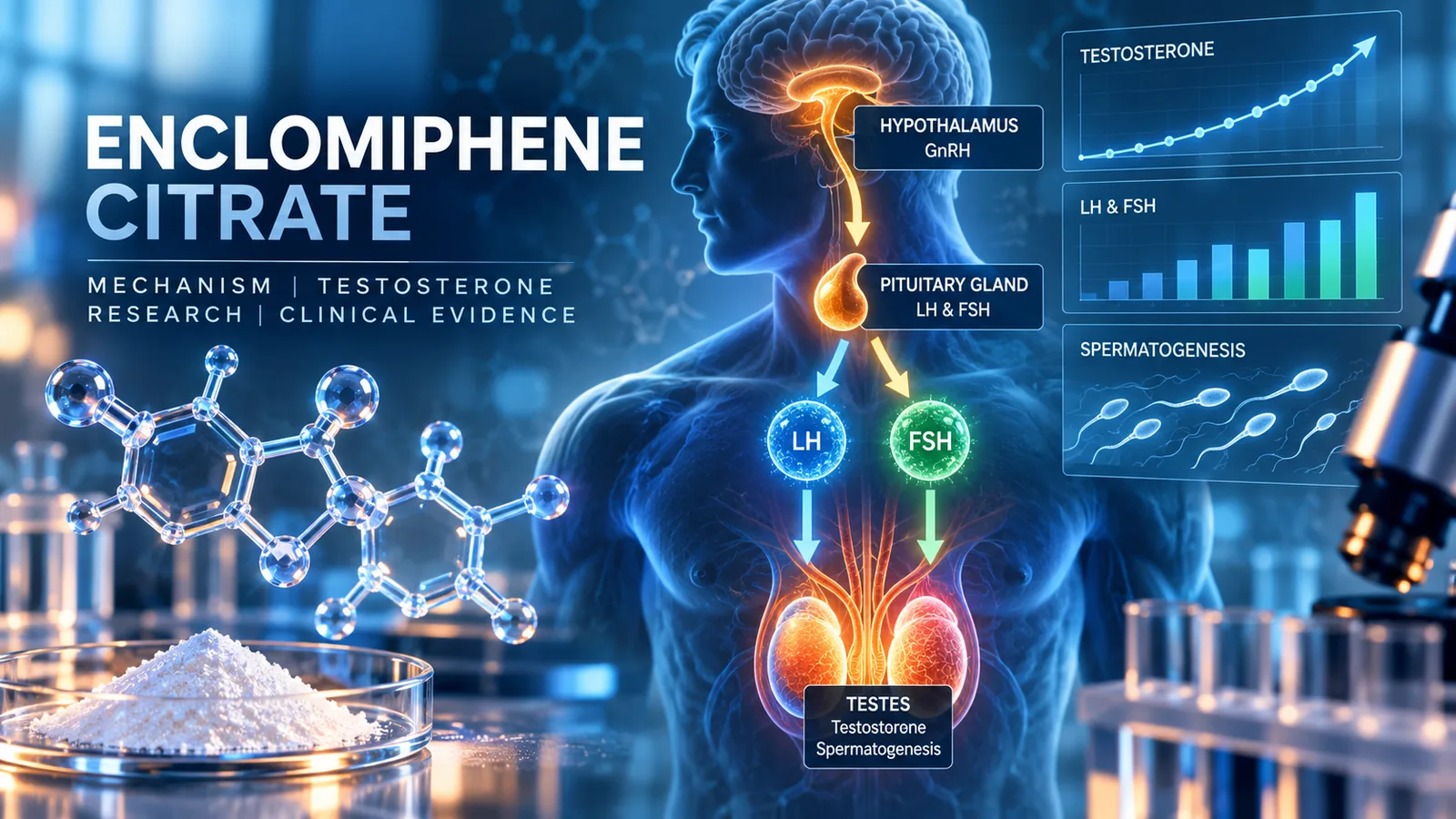
Understanding the HPG Axis
To understand enclomiphene research, it helps to understand the hypothalamic-pituitary-gonadal — or HPG — axis.
This endocrine system regulates male reproductive hormone production.
The process can be simplified into three stages.
1. The Hypothalamus
The hypothalamus releases gonadotropin-releasing hormone (GnRH).
2. The Pituitary Gland
GnRH stimulates the pituitary gland to release two important gonadotropins:
- Luteinising hormone (LH)
- Follicle-stimulating hormone (FSH)
3. The Testes
LH primarily stimulates Leydig cells in the testes to produce testosterone.
FSH, together with intratesticular testosterone and other signalling mechanisms, plays an important role in supporting spermatogenesis.
The system is regulated through negative feedback. Testosterone and estradiol generated through aromatisation provide signals to the hypothalamus and pituitary that influence further GnRH, LH and FSH secretion.
This feedback mechanism helps explain why externally administered testosterone and enclomiphene can produce very different hormonal profiles even when circulating testosterone concentrations become similar.
How Does Enclomiphene Work?
Enclomiphene acts as a selective oestrogen receptor modulator.
Its principal mechanism in male hormone research involves antagonising oestrogen-mediated negative feedback within the hypothalamic-pituitary system.
When that inhibitory feedback is reduced, signalling through the HPG axis can increase.
This can lead to greater secretion of:
- LH
- FSH
In men whose testes remain capable of responding to these signals, increased LH can subsequently stimulate greater endogenous testosterone production.
This is an important distinction.
Enclomiphene does not itself provide testosterone.
Instead, clinical research indicates that it can stimulate the endocrine signalling responsible for endogenous testosterone production.
That distinction also explains why studies have observed increases in LH and FSH with enclomiphene while exogenous testosterone tends to suppress them.
What Does Human Research Show About Testosterone?
The most useful evidence comes from controlled human trials in men with secondary hypogonadism.
A phase II study investigated enclomiphene alongside topical testosterone.
Both approaches increased serum testosterone.
However, the hormonal pathways through which this occurred were different.
Enclomiphene increased testosterone alongside increases in LH and FSH, consistent with stimulation of endogenous testicular testosterone production.
Topical testosterone increased circulating testosterone while suppressing gonadotropin signalling.
Earlier proof-of-principle research similarly demonstrated substantial increases in testosterone following enclomiphene administration. Testosterone concentrations achieved with enclomiphene and testosterone gel were broadly comparable in the study, while increases in LH and FSH occurred with enclomiphene.
The important distinction therefore is not simply whether serum testosterone rises.
It is how that testosterone concentration is achieved and what happens to the rest of the HPG axis in the process.
Enclomiphene, LH and FSH
LH and FSH provide some of the clearest evidence of enclomiphene’s mechanism.
Clinical trials have repeatedly demonstrated increases in both gonadotropins following enclomiphene.
This contrasts with exogenous testosterone, which generally reduces pituitary LH and FSH through negative feedback.
This difference matters scientifically because serum testosterone alone provides an incomplete picture of male endocrine function.
Two individuals could theoretically display similar circulating testosterone concentrations while having very different:
- LH concentrations
- FSH concentrations
- intratesticular signalling
- spermatogenic activity
For this reason, studies comparing enclomiphene with testosterone gel have measured gonadotropins and semen parameters alongside serum testosterone.
What Does Research Show About Sperm Production?
The preservation of spermatogenesis is one of the most notable findings in enclomiphene research.
In a randomised phase II study comparing enclomiphene with topical testosterone, sperm counts were conserved in the enclomiphene group while LH and FSH increased.
Larger phase III trials subsequently produced a similar pattern.
Overweight men with secondary hypogonadism were randomised to enclomiphene, testosterone gel or placebo. After 16 weeks, testosterone increased in both the enclomiphene and testosterone-gel groups.
However:
- LH and FSH increased with enclomiphene
- LH and FSH decreased with testosterone gel
- Sperm concentrations remained within the normal range in the enclomiphene groups
- Testosterone gel produced a marked reduction in spermatogenesis
This does not mean enclomiphene has been established as a fertility treatment.
Sperm concentration is a reproductive marker and is not equivalent to demonstrating improved pregnancy or live-birth outcomes.
Nevertheless, preservation of spermatogenesis represents an important mechanistic difference between stimulating endogenous testosterone production and supplying testosterone exogenously.
What Does the Latest Systematic Evidence Show?
Individual clinical trials provide valuable information, but systematic reviews can offer a broader view by examining evidence across multiple studies.
A 2025 systematic review and meta-analysis examined randomised controlled trials of selective oestrogen receptor modulators — principally clomiphene and enclomiphene — in men with functional hypogonadism.
Compared with placebo, SERM therapy was associated with significant increases in:
- Total testosterone
- LH
- FSH
The pooled increase in total testosterone compared with placebo was approximately 274 ng/dL.
Importantly, when SERM therapy was compared with testosterone gel, the analysis found no statistically significant difference in total testosterone concentrations.
However, LH and FSH remained significantly higher with SERM treatment.
Sperm concentration was also substantially better preserved in SERM-treated groups than in testosterone-gel groups.
These findings broadly reinforce the mechanism observed in earlier individual enclomiphene trials.
However, the analysis combined evidence involving clomiphene and enclomiphene, and considerable heterogeneity existed for some outcomes. It therefore should not be interpreted as proving that every pooled result applies identically to isolated enclomiphene.
Enclomiphene vs Testosterone: A Mechanistic Comparison
It can be tempting to frame enclomiphene and testosterone simply as competing methods of raising serum testosterone.
Scientifically, the distinction is more interesting than that.
Exogenous Testosterone
External testosterone increases circulating testosterone directly.
As circulating androgen and oestrogen signalling increases, negative feedback typically reduces hypothalamic and pituitary stimulation.
Consequently:
- LH tends to fall
- FSH tends to fall
- intratesticular testosterone can decrease
- spermatogenesis can be impaired
Enclomiphene
Enclomiphene works further upstream.
By reducing oestrogen-mediated negative feedback, it can increase pituitary gonadotropin signalling.
Consequently, clinical studies have observed:
- increased LH
- increased FSH
- increased endogenous testosterone
- preservation of sperm concentrations
This is why two interventions capable of producing comparable serum testosterone concentrations can have markedly different effects elsewhere in the reproductive endocrine system.
It also helps explain why enclomiphene research has focused particularly on secondary hypogonadism, where inadequate hypothalamic or pituitary stimulation contributes to low testosterone while testicular responsiveness remains.
Enclomiphene vs Clomiphene: Why the Isomers Matter
Enclomiphene and clomiphene should not be treated as interchangeable terms.
Clomiphene is a mixture of enclomiphene and zuclomiphene.
The two isomers differ in receptor behaviour and pharmacokinetics.
Enclomiphene is generally characterised as the more anti-oestrogenic isomer and has been associated with pro-gonadotropic activity — increasing LH and FSH.
Zuclomiphene exhibits greater oestrogenic activity and remains in the body considerably longer.
The different persistence and pharmacological characteristics of the two isomers provide a scientific rationale for studying enclomiphene separately rather than assuming that every effect of mixed clomiphene citrate represents the effect of its individual stereoisomers.
For a more focused examination of this distinction, see our Enclomiphene vs Clomid: Key Differences in Research article.
What Happens to Estradiol?
Discussion of SERMs sometimes creates the impression that blocking an oestrogen receptor necessarily means circulating estradiol will fall.
That is not necessarily the case.
Enclomiphene modifies oestrogen signalling at particular receptors involved in endocrine feedback; it does not simply remove oestrogen from circulation.
As endogenous testosterone production increases, more substrate can also become available for aromatisation to estradiol.
Clinical research has therefore reported increases in estradiol alongside increases in testosterone.
The 2025 meta-analysis similarly identified higher estradiol concentrations with SERM therapy than with testosterone gel in the included evidence.
This illustrates an important distinction between oestrogen receptor antagonism and lowering circulating oestrogen concentrations.
They are not the same biological process.
Does Enclomiphene Increase Free Testosterone?
Research has primarily focused on total testosterone, LH, FSH and reproductive markers, although some studies have also measured or calculated free testosterone and sex hormone-binding globulin (SHBG).
Because changes in total testosterone do not necessarily translate proportionally into changes in free testosterone, SHBG and other individual variables remain relevant when interpreting hormonal data.
The existing evidence supports a clear effect on total testosterone in appropriately selected study populations, but the broader endocrine response should not be reduced to a single laboratory measurement.
What About DHT?
Dihydrotestosterone (DHT) is produced from testosterone through the enzyme 5-alpha-reductase.
Some comparative research has reported differences in DHT between enclomiphene and testosterone treatment groups.
The 2025 systematic review identified DHT differences within the included evidence.
However, the evidence base for DHT is considerably smaller than that for testosterone, LH and FSH.
Strong conclusions about the clinical significance of these findings therefore should not be drawn from the currently available evidence alone.
Safety and Adverse Findings
Short- and medium-duration clinical studies provide useful safety information, but enclomiphene does not have the depth of long-term safety evidence available for established licensed medicines.
The 2025 systematic review found no significant overall difference in adverse-event frequency between SERM therapy, testosterone gel and placebo across the included studies.
Nevertheless, adverse findings did occur.
Individual participants in the underlying evidence discontinued treatment because of findings including elevated haematocrit or haemoglobin and elevated prostate-specific antigen (PSA).
Hormonal interventions can affect multiple physiological systems, and an apparently favourable result in one biomarker does not establish overall safety.
Long-term cardiovascular outcomes, prostate outcomes, fertility outcomes and other clinically meaningful endpoints remain insufficiently characterised.
For a more detailed examination of this area, see Is Enclomiphene Safe? Breaking Down the Research.
What Enclomiphene Research Does NOT Establish
A rigorous interpretation of the evidence requires being equally clear about what has not been demonstrated.
Existing research does not establish that enclomiphene:
- improves fertility outcomes such as pregnancy or live-birth rates
- increases muscle growth or athletic performance
- treats anxiety or cognitive impairment
- is safer than all established treatments
- has established long-term cardiovascular safety
- is appropriate for unsupervised human use
- produces the same response in every cause of low testosterone
The strongest evidence relates to endocrine biomarkers and spermatogenesis in selected populations of men with secondary or functional hypogonadism.
That is considerably narrower than many claims encountered online.
Enclomiphene, Mood and Cognitive Research
Testosterone and oestrogen signalling interact with the central nervous system, which has generated interest in possible relationships between hormonal restoration, mood and cognitive function.
However, there is currently insufficient direct clinical evidence to conclude that enclomiphene itself reduces anxiety, improves cognition or enhances focus.
This distinction is important.
Evidence that low testosterone may correlate with certain psychological symptoms does not automatically demonstrate that a particular testosterone-modulating compound treats those symptoms.
Our separate articles examining Enclomiphene and cognitive function and Enclomiphene and anxiety explore these hypotheses in greater detail while distinguishing indirect mechanistic reasoning from direct enclomiphene evidence.
Why Secondary Hypogonadism Matters
Enclomiphene’s mechanism depends upon a functioning HPG axis and testes capable of responding to increased gonadotropin stimulation.
This makes the distinction between primary and secondary hypogonadism important.
In primary testicular failure, LH and FSH may already be elevated because the pituitary is attempting to stimulate inadequately responsive testes.
Increasing gonadotropin signalling in such circumstances is biologically different from addressing secondary hypogonadism, where LH may be low or inappropriately normal.
The major enclomiphene trials therefore should not be generalised indiscriminately to every form of testosterone deficiency.
Regulatory Status of Enclomiphene
Despite undergoing phase II and phase III clinical development, enclomiphene is not currently approved by the U.S. Food and Drug Administration (FDA) or European Medicines Agency (EMA).
It is also not a licensed medicine in the UK.
The British Society for Sexual Medicine’s 2026 position statement discusses enclomiphene as a potentially useful approach to secondary male hypogonadism while highlighting its unlicensed status and the need for adequate long-term efficacy and safety evidence.
This regulatory history is important.
Completion of clinical trials — including phase III trials — should not be confused with regulatory approval.
Similarly, evidence that a compound alters testosterone or reproductive biomarkers does not establish approval for therapeutic use.
Product Identity, Purity and Analytical Testing
When studying any research compound, conclusions are only as reliable as the identity of the material being investigated.
Published clinical evidence relates to characterised enclomiphene citrate used under controlled study conditions.
Material obtained outside those trials cannot simply be assumed to have identical identity, purity or composition.
Analytical techniques can help investigate these characteristics.
Depending on the analytical question, methods may include:
- High-performance liquid chromatography (HPLC)
- Mass spectrometry (MS)
- Other appropriate analytical techniques
A Certificate of Analysis can provide information about a particular tested sample or batch.
However, a COA should not be interpreted as proof that a compound is medically approved, safe, effective or suitable for human consumption.
At Affordable Nutrition UK, relevant analytical documentation is made available where applicable so that product information can be assessed alongside the broader scientific literature.
For more information about our approach to analytical transparency, see Testing & Quality.
Why Enclomiphene Has Become an Important Research Compound
Enclomiphene is scientifically interesting because it allows researchers to investigate testosterone restoration through a fundamentally different endocrine pathway from exogenous testosterone.
Its research profile brings together several areas:
- selective oestrogen receptor modulation
- HPG-axis signalling
- endogenous testosterone production
- LH and FSH regulation
- spermatogenesis
- stereoisomer pharmacology
The strongest evidence does not come from claims about bodybuilding, mood enhancement or performance.
It comes from controlled clinical research showing that enclomiphene can increase testosterone while simultaneously increasing gonadotropins and maintaining sperm concentrations in studied men with secondary hypogonadism.
That combination makes it a particularly interesting compound for investigating the relationship between endocrine feedback and male reproductive physiology.
Enclomiphene Research: The Overall Evidence
The current evidence supports several reasonably robust conclusions.
Enclomiphene is the trans-isomer of clomiphene and acts as a selective oestrogen receptor modulator.
By reducing oestrogen-mediated negative feedback within the HPG axis, it can increase LH and FSH signalling.
Controlled human studies have demonstrated increases in serum testosterone in men with secondary hypogonadism.
Unlike exogenous testosterone, enclomiphene has generally increased rather than suppressed LH and FSH.
Clinical trials have also demonstrated preservation of sperm concentrations during enclomiphene treatment, whereas testosterone gel reduced spermatogenesis in comparative studies.
Recent systematic evidence broadly supports these endocrine findings.
However, substantial questions remain.
Long-term clinical outcomes are incompletely characterised. The compound remains unlicensed in the UK and unapproved by the FDA and EMA. Evidence relating to mood, cognition, athletic performance and other frequently discussed outcomes remains substantially weaker than the evidence for endocrine biomarkers.
For that reason, enclomiphene is best understood through what controlled research actually demonstrates rather than through claims extrapolated beyond the available evidence.
Enclomiphene FAQs
Is Enclomiphene the Same as Clomid?
No. Clomid, or clomiphene citrate, contains two stereoisomers: enclomiphene and zuclomiphene. Enclomiphene is the trans-isomer and can be studied independently of the longer-lasting, more oestrogenic zuclomiphene isomer.
Does Enclomiphene Increase Testosterone?
Controlled human trials in men with secondary hypogonadism have demonstrated increases in serum testosterone following enclomiphene. Importantly, these increases occurred alongside increases in LH and FSH, consistent with stimulation of endogenous testosterone production.
Does Enclomiphene Suppress LH and FSH?
The clinical evidence generally shows the opposite. Enclomiphene increased LH and FSH in comparative trials, whereas exogenous testosterone suppressed these gonadotropins.
What Does Research Show About Enclomiphene and Sperm Count?
Clinical studies found that sperm concentrations were maintained during enclomiphene treatment, while testosterone gel reduced spermatogenesis. Preservation of sperm concentration should not, however, be interpreted as proof of improved fertility, pregnancy or live-birth outcomes.
Is Enclomiphene Approved as a Medicine?
Enclomiphene is not currently approved by the FDA or EMA and is not a licensed medicine in the UK. Its investigational and regulatory status should be distinguished from the clinical research conducted on it.
Why Does Product Purity Matter in Enclomiphene Research?
Scientific conclusions depend on knowing what material is actually being studied. Analytical testing can provide information about the identity and purity of a particular sample or batch, but such testing does not demonstrate safety, efficacy or regulatory approval.
Conclusion
Enclomiphene occupies an unusual position in male hormone research.
It has progressed through controlled human trials and has demonstrated reproducible effects on important endocrine markers, yet it remains investigational and important long-term clinical questions remain unanswered.
Its most compelling scientific characteristic is not simply that testosterone increased in clinical studies.
It is that testosterone increased while LH and FSH signalling remained active and sperm concentrations were preserved.
That distinguishes its mechanism from exogenous testosterone and provides a valuable model for investigating how the HPG axis, endogenous testosterone production and male reproductive function interact.
At the same time, the evidence should not be stretched beyond what has actually been demonstrated.
A research-led understanding of enclomiphene therefore requires both sides of the picture: promising and consistent endocrine findings alongside clear limitations in long-term clinical evidence and regulatory approval.
Scientific References
- Kaminetsky J, Werner M, Fontenot G, Wiehle RD. Oral enclomiphene citrate stimulates the endogenous production of testosterone and sperm counts in men with low testosterone: comparison with testosterone gel. Journal of Sexual Medicine. 2013;10(6):1628–1635.
- Wiehle RD et al. Enclomiphene citrate stimulates testosterone production while preventing oligospermia: a randomized phase II clinical trial comparing topical testosterone. Fertility and Sterility. 2014;102(3):720–727.
- Kim ED et al. Oral enclomiphene citrate raises testosterone and preserves sperm counts in obese hypogonadal men, unlike topical testosterone: restoration instead of replacement. BJU International. 2016.
- Clomiphene or enclomiphene citrate for the treatment of male hypogonadism: a systematic review and meta-analysis of randomized controlled trials. Archives of Endocrinology and Metabolism. 2025.
- Rodriguez KM, Pastuszak AW, Lipshultz LI. Enclomiphene citrate for the treatment of secondary male hypogonadism. Review of clinical development evidence.
- British Society for Sexual Medicine. Position Statement for the Potential Use of Enclomiphene in the Treatment of Male Hypogonadism. 2026.
Research Notice: This article is provided for educational and research purposes only. Enclomiphene remains unlicensed in the UK and is not approved by the FDA or EMA. The information presented summarises published research and should not be interpreted as medical advice, evidence of suitability for human use, or a recommendation for treatment.