
One thing I’ve learnt throughout my years of bodybuilding is that even the smallest adjustments to an exercise can sometimes make a noticeable difference to how it feels.
Changing your grip, rotating your wrists or altering the position of your hands may influence how comfortably and effectively you perform certain movements.
I remember experimenting with something as simple as the position of my little finger during dumbbell exercises.
It’s an interesting example of how understanding the mechanics of a movement can help you become more aware of the muscles you’re training.
However, what works well for one exercise doesn’t necessarily apply to another.
The Little-Finger Technique During Biceps Curls
The biceps perform two important functions: bending the elbow and helping rotate the forearm so the palm faces upwards.
This second movement is known as supination.
When performing alternating dumbbell curls, you can begin with your palms facing inwards and gradually rotate your forearms as you raise the weights.
By the top of the movement, your palms will generally be facing upwards.
You may notice that the little-finger side of your hand naturally turns upwards as your forearm rotates.
This is the principle behind the traditional bodybuilding tip of bringing the little finger upwards during a curl.
The important point is that the movement comes from rotating the forearm, not forcibly bending or twisting the wrist.
There’s no need to exaggerate the position or attempt to rotate beyond your comfortable range.
It’s simply one variation worth exploring when performing dumbbell curls.
For more practical ideas on developing your biceps and triceps, read my Are Your Arms Lagging? Training Tips.
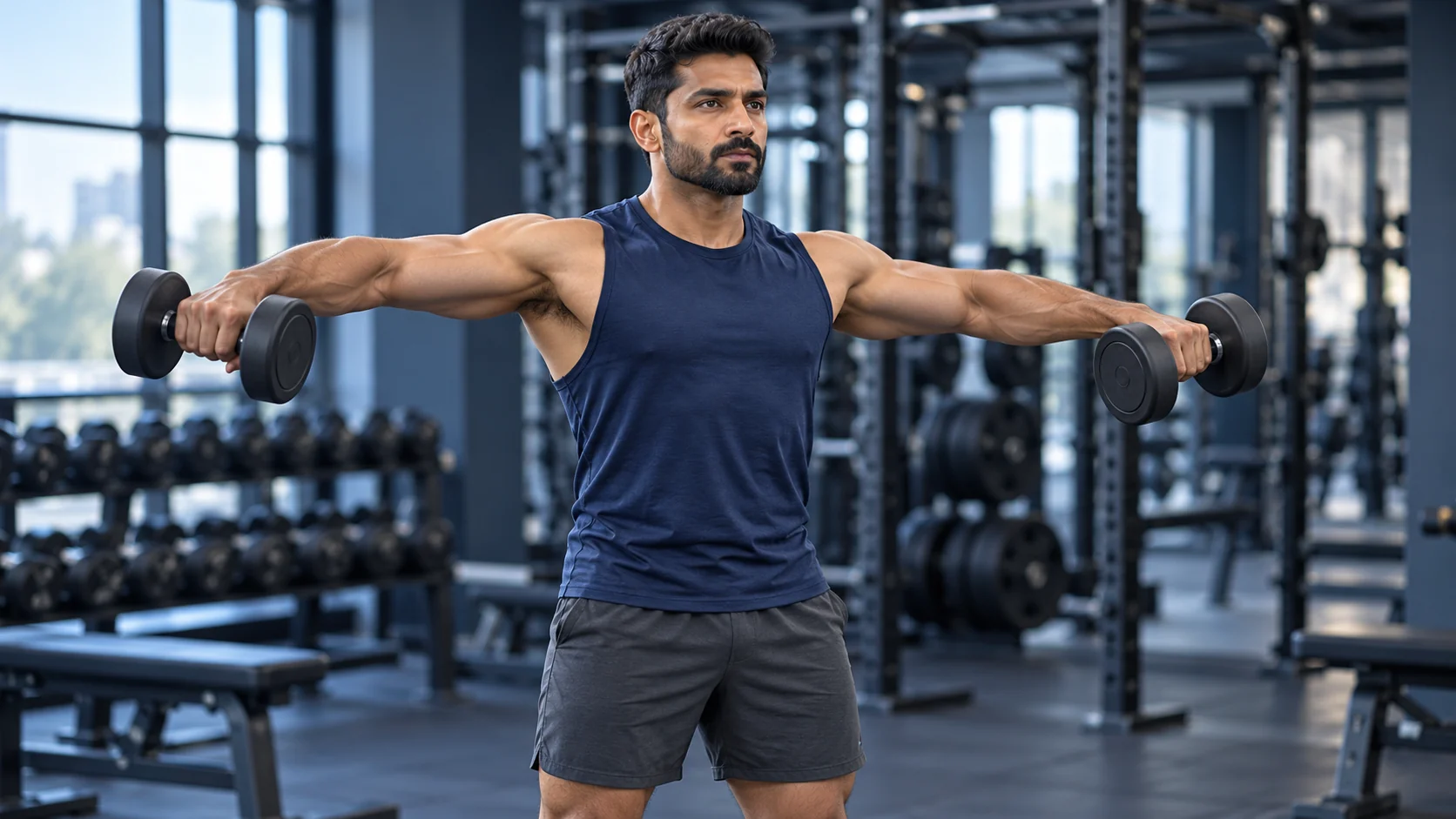
Why Lateral Raises Are Different
The same little-finger advice is sometimes applied to dumbbell lateral raises.
You may have heard the suggestion to lift the little finger higher than the thumb, almost as though you’re pouring water from a jug.
Although this was a popular bodybuilding technique, deliberately turning the thumbs down introduces greater internal rotation at the shoulder.
This position isn’t automatically harmful, but it may be uncomfortable for some people, particularly when combined with raising the arms.
For many lifters, a neutral or slightly thumbs-up hand position can provide a more comfortable alternative.
The objective is to raise the arms in a controlled manner while maintaining a movement that suits your shoulder mechanics.
There’s no need to force a particular wrist or shoulder position simply because it has traditionally been associated with better deltoid development.
Small Changes, Better Understanding
I think the real value of experimenting with hand position is learning how your own body responds to different exercises.
For example, you might find that:
-
Rotating your forearm during dumbbell curls feels more natural than maintaining a fixed grip.
-
A neutral hand position makes lateral raises more comfortable.
-
Different dumbbell grips influence how easily you control a movement.
-
Making a minor adjustment allows you to perform an exercise more consistently.
These differences don’t necessarily mean one variation will produce greater muscle growth.
What matters is finding movements that are comfortable, appropriate for your goals and allow you to progress over time.
Our Understanding Your Exercises guide explores this individual approach to exercise selection in greater detail.
Don’t Overcomplicate the Fundamentals
It’s easy to become so interested in small training adjustments that you forget the principles that matter most.
Appropriate resistance, controlled execution, consistent progression and sufficient recovery remain the foundations of effective resistance training.
Hand position can be worth considering, but it shouldn’t become more important than performing the exercise properly.
I’ve always believed that understanding why you’re making an adjustment is more valuable than simply copying a technique because another bodybuilder recommends it.
For a broader discussion of the fundamentals, visit my Training Technique: Building the Foundations for Muscle Growth.
Final Thoughts
Sometimes bodybuilding progress comes from major changes to your training programme. At other times, it’s about developing a better understanding of the exercises you’re already performing.
The traditional little-finger technique is an interesting example.
During dumbbell curls, forearm rotation has a clear anatomical purpose. During lateral raises, however, deliberately turning the thumbs down isn’t necessary and may not suit everyone.
After years of training, I’ve learnt that the best adjustments are those that make an exercise feel more natural, controlled and productive — not simply more complicated.
Experiment sensibly, pay attention to your mechanics and allow your training experience to guide your choices.